
In the Media

INSIGHT ON PODCAST
The Product Manager Mindset: Why Prompting Isn't the Path to AI ROI
AI workflow integration is the missing link between AI experimentation and measurable business returns. Melissa Valentine, professor at Stanford University, senior fellow at the Stanford Institute for Human-Centered AI and co-author of Flash Teams, draws on field research to show that the highest-impact AI users share a specific set of behaviors — and none of them center on prompting skill.
THE CULTURE KIT PODCAST WITH JENNY & SAMEER
Melissa Valentine on Assembling Your 'Avengers': Flash Teams in the Age of AI
We tend to treat organizational structures—such as job titles, departments, and reporting lines—like furniture: always there, moved around a bit, but rarely questioned. But what if AI is about to redesign the whole office? And in a world where you have humans and agents working alongside each other, how can leaders build a cohesive culture?
JOURNAL OF ORGANIZATION DESIGN
When an AI “Agentforce” enters the workforce: generative AI, employment relations, and the changing social contract
This article examines how AI agents become integrated into organizations as collaborators, raising new questions about coordination and human-AI work arrangements.
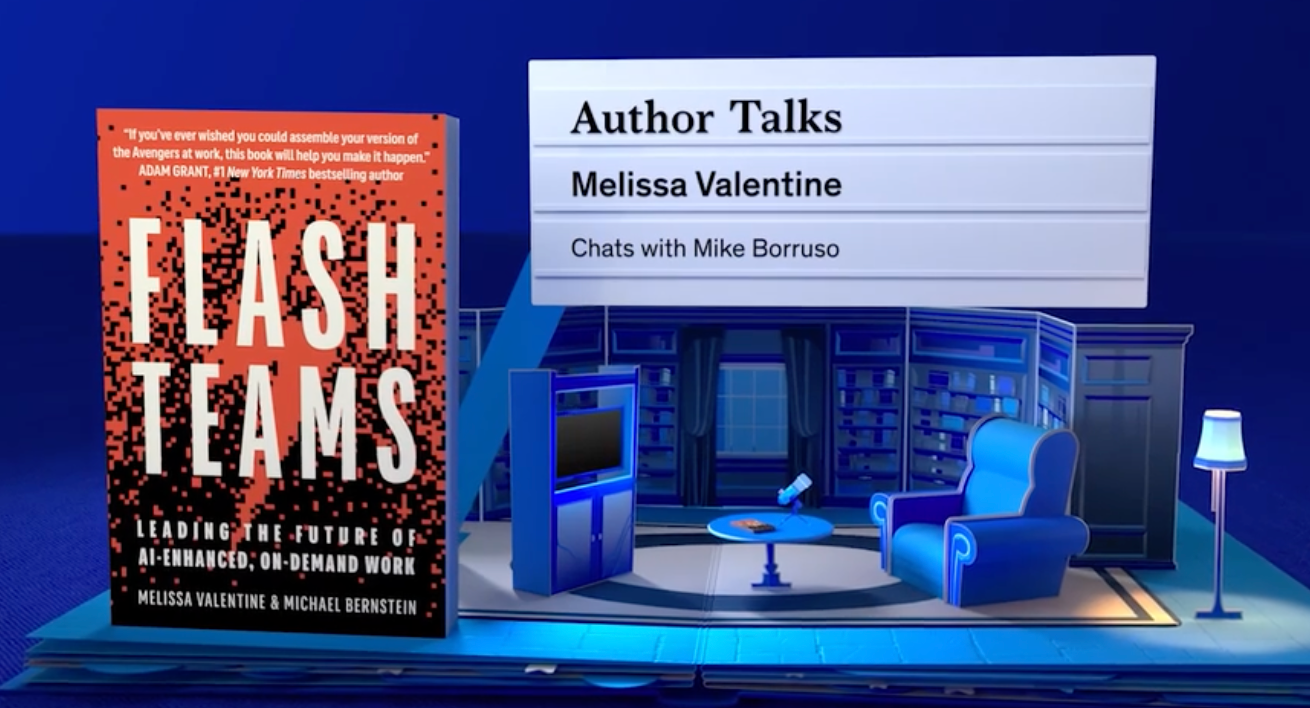
AUTHOR TALKS: MCKINSEY & COMPANY
Author Talks: How AI-Powered Teams Could Transform the Future of Work
Melissa Valentine shares how flash teams can optimize team assembly and workflow to provide a new managerial superpower for business leaders. This approach transforms traditional team structures, enables more data-driven decision-making, and drives better project outcomes.

HARVARD BUSINESS REVIEW
To Drive AI Adoption, Build Your Team's Product Management Skills
Much of the conversation about how to work effectively with generative AI has focused on prompt engineering or, more recently, context engineering: the semi-technical skill of crafting inputs so that large language models produce useful outputs. These skills are helpful, but they are only part of the story. The real payoff comes when employees learn how to apply generative AI in their day jobs in a way that improves how they work.

THE NEXT BIG IDEA BOOK CLUB
Experts, Assemble!
Two Stanford professors' playbook for building elite, AI-enhanced, on-demand teams of business superheroes

UPWORK
Flash Teams as the Future of Work: A Conversation with Dr. Melissa Valentine and Dr. Michael Bernstein
As AI innovation accelerates and organizations infuse AI tools into everything from product development to customer experience, many traditional work structures– foundational to how companies hire, develop and reward– have proven too slow for today’s rapid pace of change. One of those traditional structures is teams.
HBR IDEACAST
Supercharging Innovation with “Flash Teams”
Across industries, organizations are struggling to move as quickly as they need to on key priorities and new initiatives. The solution for many, says Stanford’s Melissa Valentine, might be “flash teams” — project groups that can be instantly, efficiently, and cost-effectively brought together and organized via online labor markets and AI and other digital tools to solve any problem. She explains why companies and leaders should embrace this new type of collaboration, how flash teams work in practice, and the pitfalls to look out for. Valentine is coauthor along with Michael Bernstein of the book Flash Teams: Leading the Future of AI-Enhanced, On-Demand Work.

HUMAN CLOUD
Melissa Valentine, Associate Professor at Stanford & Author of Flash Teams
Melissa Valentine, Associate Professor at Stanford and author of Flash Teams, joins Matthew Mottola and Tony Buffum to break down how teams form, work, and scale in the human cloud. Melissa explains what Flash Teams are, why they unlock speed and expertise, and how leaders can access talent on demand without losing culture or control.
HARVARD UNIVERSITY

Seminar Highlights: Melissa Valentine & Michael Bernstein on Flash Organizations
The Digital Seminar series hosted Melissa Valentine and Michael Bernstein from Stanford University for a talk titled “Flash Organizations: Crowdsourcing Complex Work Using Reconfigurable Organizational Structures.”
READ
THE NEW YORK TIMES

The Pop-Up Employer: Build a Team, Do the Job, Say Goodbye
At first glance, the organization chart for the maker of True Story, a card game and mobile app in which players trade stories from their daily lives, resembled that of any company. There was a content division to churn out copy for game cards; graphic designers to devise the logo and the packaging; developers to build the mobile app and the website. There was even a play-testing division to catch potential hiccups.
